|
Extreme 6
Using Empress in the
RTLinux Environment
Introduction
Empress RDBMS have many characteristics which makes it an excellent fit
for real-time systems, such as: small footprint, fast performance,
near zero maintenance, fast learning curve, ease of integration, rapid
application development, etc. In RTLinux environment Empress RDBMS is
used as a full blown Linux implementation. Hence, it will give
all the benefits of Linux features to real-time application
developers.
What is RTLinux?
RTLinux is a hard real-time operating system that runs real-time tasks
as threads (i.e. real-time applications written using RTLinux API) and
a Linux operating system as its lowest priority execution thread. All
the operations/processes which Linux itself runs are non-real
time and hidden in a way from RTLinux. Developers of RTLinux made
it possible that real-time threads and interrupt handlers are never
delayed by non-real-time operations.
Real-time tasks in RTLinux can communicate with Linux processes via shared
memory or a file-like interface (FIFO). Thus, real-time
applications can make use of all the powerful, non-real-time services of Linux,
such as Empress RDBMS.
Real-time tasks can be developed using a number of API calls (about 50),
such as:
rtl_hard_disable_irq
rtl_hard_enable_irq
rtl_no_interrupts
rtl_request_irq
rtl_restore_interrupts
rtl_setclockmode
rtl_stop_interrupts
...
"RT-Linux is simple, providing only a bare minimum of functionality
necessary for implementing a real-time system. But this simplicity
is to the system designer's benefit. You want to implement the bulk
of the application in Linux processes because Linux itself is
solid, stable, and popular with a lot of desktop users-so you know
you can get help if you have trouble. Real-time tasks should have
only the functionality necessary to perform real-time I/O and pass
data to and from the Linux processes. The simplicity of RT-Linux
has two advantages: first, its very simplicity makes it less likely
that it will be buggy; and second, if you do find a bug, it's
likely to be easy to find and fix. These factors are important.
Because real-time systems are a minuscule portion of Linux
applications, the amount of help you can find for developing code
using RT-Linux is certain to be low. So a feature-rich RT-Linux is
not necessarily something to be desired. The functionality now
implemented is also sufficient for the vast majority of real-time
systems if properly used"[2].
Empress in RTLinux Environment
Empress Software follows the basic idea on how the applications
should be run on RTLinux. Empress application will run as
Linux application and communicate with real-time tasks
via FIFO or shared memory. Figure 1. shows possible
scenarios for Empress applications in order to communicate
with real-time tasks.
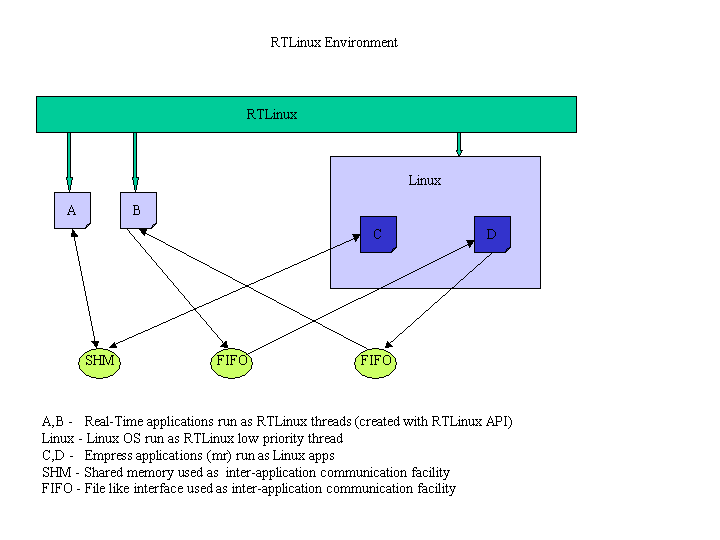
Figure 1.
Empress in RTLinux Environment
Application developers can use any Empress
C application interface (e.g. mr, mx, Embedded Static or Dynamic
SQL, ODBC) to build an application which will communicate with
hard real-time tasks.
The idea behind RTLinux is to build Empress Linux applications in Linux
environment and build simple hard real-time tasks using RTLinux API calls.
Figure 2 shows an example based on RTLinux scheduling accuracy
measuring example (created by Michael Barabanov - part of RTLinux package).
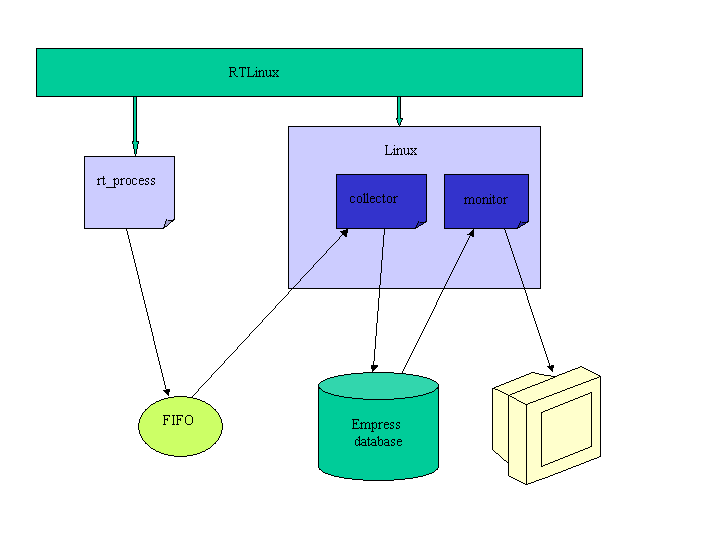
The example consists of three components:
-
rt_process: real-time task which generates real-time data.
-
gathers min_diff and max_diff.
-
min_diff: is the minimum real-time task latency (how much time a task ran late)
in nanoseconds during a measurement cycle.
-
max_diff: is the maximum real-time task latency. The jitter is a difference (max_diff -min_diff).
-
writes real-time data onto FIFO
-
collector: user process for database insertion
(Empress "mr" application)
-
reads real-time data from FIFO
-
writes data into the database
-
monitor: user process to monitor real-time data in the database
(Empress "mr" application)
-
shows a recent 20 records from the database
-
navigates with the "Page Up" and the "Page Down" key
-
saves the database into the floppy diskette
-
toggles the automatic display of real-time data by "Home" key
Empress Software Inc. has the above demo available on its FTP site.
This example shows a possible way to integrate Empress
application with real-time tasks. It could be used as a template for
more generic "data streaming" situation. For example, a typical case
would be a real-time data acquisition task
which monitors/gathers data from instruments/gages/sensors.
References
[1] Michael Barabanov, Victor Yodaiken: "Real Time Linux",
Linux Journal, February 1997.
[2] Jerry Epplin: "Linux as an Embedded Operating System",
Embedded Systems Programming.
www.embedded.com
[3] The Wikipedia page for RTLinux or http://en.wikipedia.org/wiki/RTLinux
|